The New Front Door to Healthcare Isn’t a Portal. It’s AI.
Renya Spak, Chief Growth OfficerFor more than 10 years, digital health has promised disruption. While many solutions have delivered clinical value, they have also contributed to an increasingly fragmented experience, with members navigating competing portals, disconnected programs, and a growing number of vendors competing for their attention.
Meanwhile, healthcare costs are rising at the fastest rates in decades and engagement remains stubbornly low. Benefits leaders are right to ask: Will AI-powered digital health finally be different?
The answer may lie less in the technology itself and more in how consumers are already choosing to engage with it. According to OpenAI’s AI as a Healthcare Ally report, more than 40 million people now ask ChatGPT healthcare questions every day, including roughly 2 million questions each week about health insurance, plan design, and claims. More than 70% of these interactions occur outside traditional business hours or in areas with limited access to care.
Healthcare consumerism is no longer a future trend; it is happening now. Employees are using consumer AI to make sense of symptoms, diagnoses, coverage decisions, provider options, pharmacy questions, and confusing medical bills. They are not starting with a benefits portal or calling the number on the back of their insurance card. They are turning to ChatGPT and Claude for immediate, jargon-free guidance in moments that matter: when a child develops a fever late at night, when a parent receives a new diagnosis, when a bill arrives unexpectedly, or when they are deciding whether a health concern warrants care.
The question for benefits leaders is no longer whether employees will use AI to navigate healthcare. They already are. The question is whether employers will provide a safer, smarter, and more contextual experience before consumer AI becomes the default front door to healthcare.
Stop, Step Aside, or Step In?
When consumer behavior moves this quickly, benefits leaders have three choices.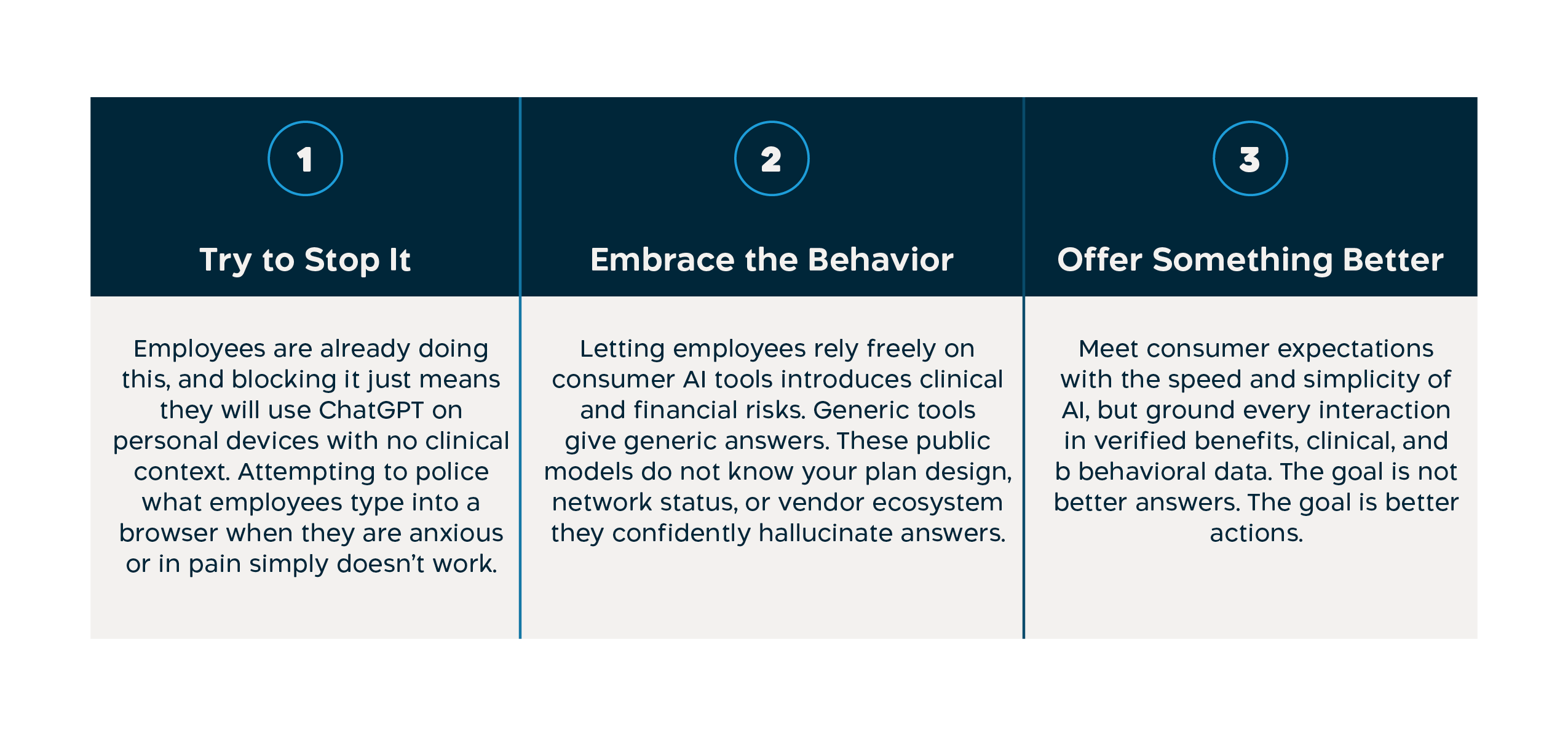
AI Needs Two Things to Be Useful in Healthcare
True utility in healthcare AI requires two things: speed and a reliable source of truth. Public AI has the engine, but not the truth. Legacy benefits portals may have pieces of the data, but they lack the engine.
A large language model can make a generic answer sound incredibly personalized, but unless the system understands the member’s actual health history, benefits, incentives, preferences, and next-best action, it operates in a vacuum.
If an employee asks a public AI tool, “I have sharp pain in my lower back; what should I do?” it will provide a reasonable, abstract list: rest, ice, or physical therapy.
But healthcare doesn’t happen in the abstract. That AI doesn’t know the employee had spinal surgery three months ago, where the nearest physical therapy clinic is in-network, or that the employer already offers a musculoskeletal solution. It does not know whether the employee has ignored five prior messages about that solution, but responds well to rewards. It does not know the claims, care gaps, benefits, incentives, preferences, or behavioral signals that determine the truly personalized, contextually relevant next step.
That is the context gap, and it’s where employer ROI fails to materialize.
The Next Era is Behavior Change, Not Navigation
The real promise of AI is spotting patterns, reading signals, anticipating friction, and orchestrating the next best action across the benefits ecosystem.
The next era of digital health will not be defined by navigation. It will be defined by behavior change. Navigation tells people where to go. Behavior change helps them actually get there.
It should be able to recognize when a member is likely to need support before a high-cost event occurs. It should know which employer-paid program is relevant. It should understand which intervention is clinically appropriate, financially efficient, and behaviorally likely to work. It should know when a nudge is enough, when a reward is useful, when a human should step in, and when accuracy requires hard-coded logic rather than generative output.
This is where AI becomes strategic for benefits leaders. Employees already expect more. Consumer AI has moved fast, and people now have a baseline for what personalized, specific guidance feels like. They’re going to bring that expectation to every application they use. This is the difference between a chatbot and an AI health engine.
The Vendor Questions To Ask
You do not need to be an AI expert to vet a solution. Ask vendors two questions:
What unique, verified data does your AI use that it did not simply inherit from a foundation model or scrape from the open web?
How does that data change the action recommended
If the answer is mostly about the large language model, be skeptical. The model is not the strategy. The model is one ingredient. The real value comes from the intelligence layer around it: the claims data, eligibility, plan design, network information, vendor ecosystem, incentives, engagement history, clinical rules, human oversight, privacy framework, and causal models that determine what action should happen next.
Intelligence is what then builds trust in your strategy. When an AI gives a generic recommendation, trust erodes. When it routes someone to the wrong provider, trust erodes. When it misunderstands coverage, trust erodes. When it feels creepy rather than helpful, trust erodes. And when trust erodes, employees do not blame the algorithm. They blame HR. Trust is the baseline condition for engagement.
The Employers Who Win Will Offer Something Better
We are in a critical adoption window. A recent WTW report, 2026 AI Use in Health and Benefits Survey, found that while only 20% of employers actively use AI in benefits today, 72% plan to embed it within the next 24 months.
Doing nothing means letting employees rely on public AI tools that lack safety guardrails. Foward thinking employers will use AI to transform basic benefits data into a personalized daily health partner.
AI should not be another layer of spend. It should be the execution layer that helps employers get more value from the benefits they already pay for.
Employees have already chosen AI as part of their healthcare journey. The employers who win will not be the ones who resist that behavior. They will be the ones who channel it toward better decisions, better outcomes, and greater value from every dollar they already invest in benefits.