Calibrating Persistence: How Personalized AI Nudges Drive Measurable Medical Savings
Gary Loveman, Co-Founder and CEO“A friend received a polite no from a woman he asked out, so he sent her flowers and tried again. The answer remained no, so he kept trying. After 26 more weekly deliveries, his florist told him that he was the saddest customer they had ever served. But my friend persevered, and after the 50th delivery, a date was secured. My friend has now been married to this woman for more than 35 years.
To be clear, this is not an endorsement of ignoring boundaries. Persistence works only when it is calibrated to readiness and grounded in trust.
This story should come as no surprise to consumers who are reminded repeatedly to reconsider a purchase they once contemplated. The lesson is simple: Persistence works in love, in marketing, and yes, even in health.”
Adults simply do not change behavior when asked once or twice, or when pressed into an isolated action to meet a requirement or grab an incentive. Rather, adults change health behavior when a persistent, supportive and trusted advocate provides enough motivation to overcome the friction that impedes action. And when action is taken, the advocate congratulates, rewards and keeps encouraging.
Yet most corporate well being programs still act as if one reminder is enough. But the challenge is more nuanced: the more demanding the health action, the more persistence is required. And, the less adherent the individual, the more persistence is required. This isn’t about willpower. It’s a predictable behavioral pattern.
The higher the friction, the more persistence is required.
Every health behavior has a “friction level” that determines how much support people need. The chart on the next page shows the typical number of interactions required across millions of engagements — from 8 or 9 touches for stress or anxiety management, to 20-plus for breast cancer screening, to nearly 40 for diabetes medication adherence.
Preventive care and chronic condition adherence require significantly more persistence not because the benefits are distant, but because the barriers are immediate: fear of diagnosis, denial, low urgency, confusing instructions, and logistical challenges. These forces create real inertia.
For example, a cancer screening is a difficult action for anyone, but it is especially hard to motivate among those who are generally less adherent to healthy behaviors. High friction actions such as preventive screenings, medication adherence, and chronic condition management consistently require far more support than lower friction behaviors.
In large populations, the level of persistence necessary to stimulate a given health action varies widely across individuals. In a study of nearly 79,000 breast cancer screening observations, conversion rates increased sharply from the first to the second intervention, peaking among members who received two touches. Beyond that point, conversion to action declined, but significant numbers of recipients were spurred to action by high levels of persistence in messaging.

This does not mean persistence is unproductive. Rather, it means persistence must be intelligent. Members who require more than five interventions represent a distinct, highly resistant subpopulation. Their lack of response reflects high levels of friction: fear of diagnosis, competing demands, irrationally low perception of risk, and prior disengagement.
In fact, while a small number of these individuals eventually act after dozens of touches, the standard intervention mix loses effectiveness unless it evolves.
Some individuals respond after one or two prompts. Others require sustained, varied support over time. Persistence works when it is calibrated to readiness, not when it is applied indiscriminately. This is why personalization is not optional. It is the mechanism that allows persistence to remain effective rather than wasteful.
The implication is critical: effective health engagement is not about applying more pressure uniformly, but about learning when persistence needs to change form.
Why this matters for employers facing rising healthcare costs
Driving meaningful health improvement requires dynamic, personalized intervention intensity because the level of persistence needed varies by behavior. Not once a year. Not once a month. But dozens of timely micro-touches over time.
Traditional healthcare simply can’t deliver this. Adults see a physician one to three times a year for roughly 17 minutes which is far too few touchpoints to influence the many micro-decisions that shape chronic outcomes. But if an outcome requires 20, 40, or even 92 moments of persistence, someone or some tool must be able to deliver them reliably, affordably, and at scale.
And the only way to do that is through technology. AI, machine learning, and behavioral science working together to deliver small, context-aware actions that compound into meaningful health and cost improvements.
For employers, this reframes cost control. It’s not about one big intervention. It’s about hundreds of small, right-time actions that add up and drive optimal behaviors across sophisticated plan design and point-solution offerings.
How Well operationalizes persistence
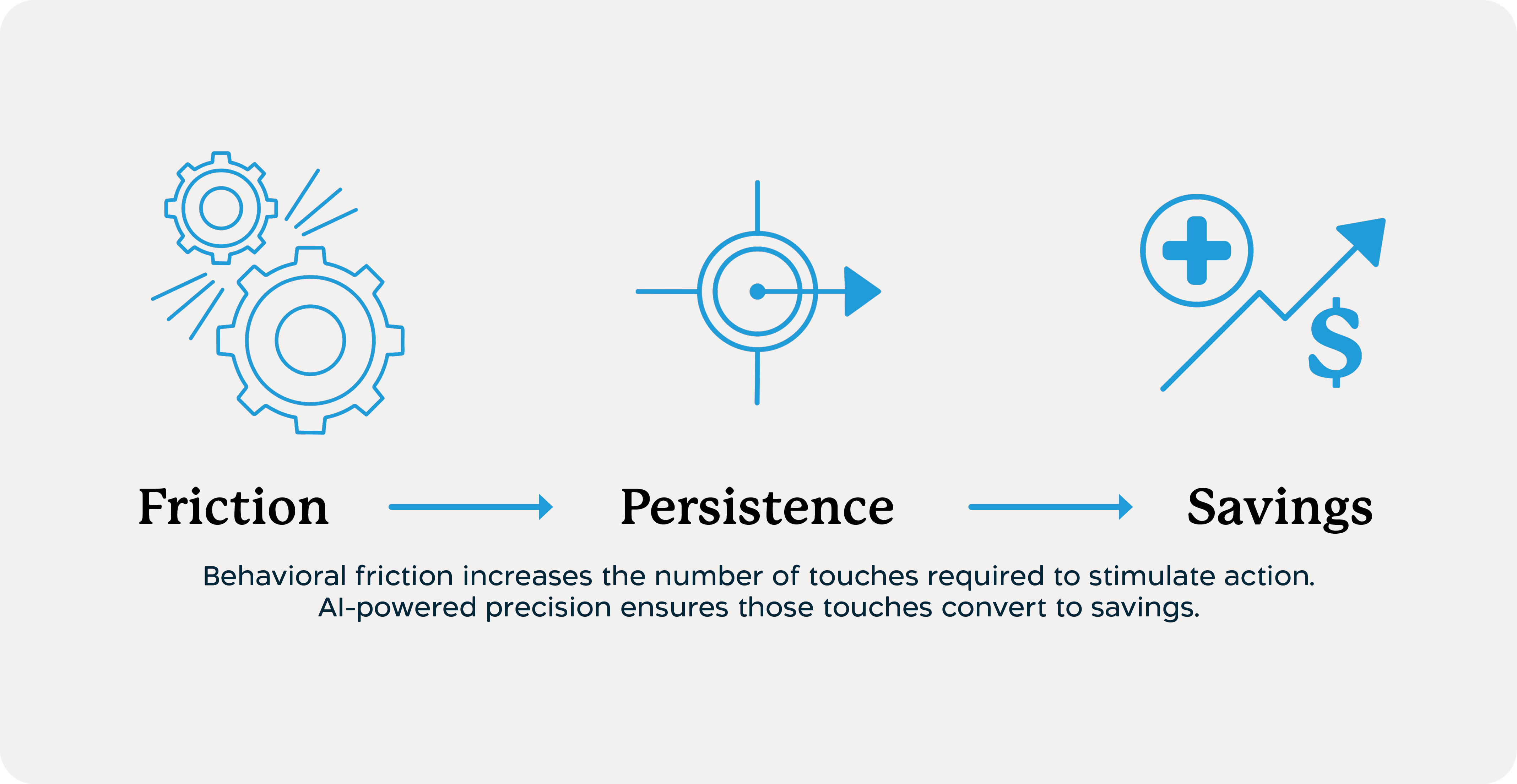
Well is the first dynamic engagement system built to quantify exactly how much persistence each health outcome requires and then deliver it efficiently and precisely because we operate as each member’s daily health partner. Over 25% of our membership engage with Well every single day.
This enables us to be persistent while maintaining a NPS score that hovers around 90 and:
- Predict the intensity needed before someone becomes high-cost
- Use the fewest touches for the greatest clinical and financial impact
- Tie engagement directly to medical savings with actuarial-grade confidence
- Match incentive spend to real behavioral yield
- Outperform traditional programs on the high-friction behaviors that matter most
- We now understand the behavioral math behind cost control and we’ve built the engine that can execute it at enterprise scale.
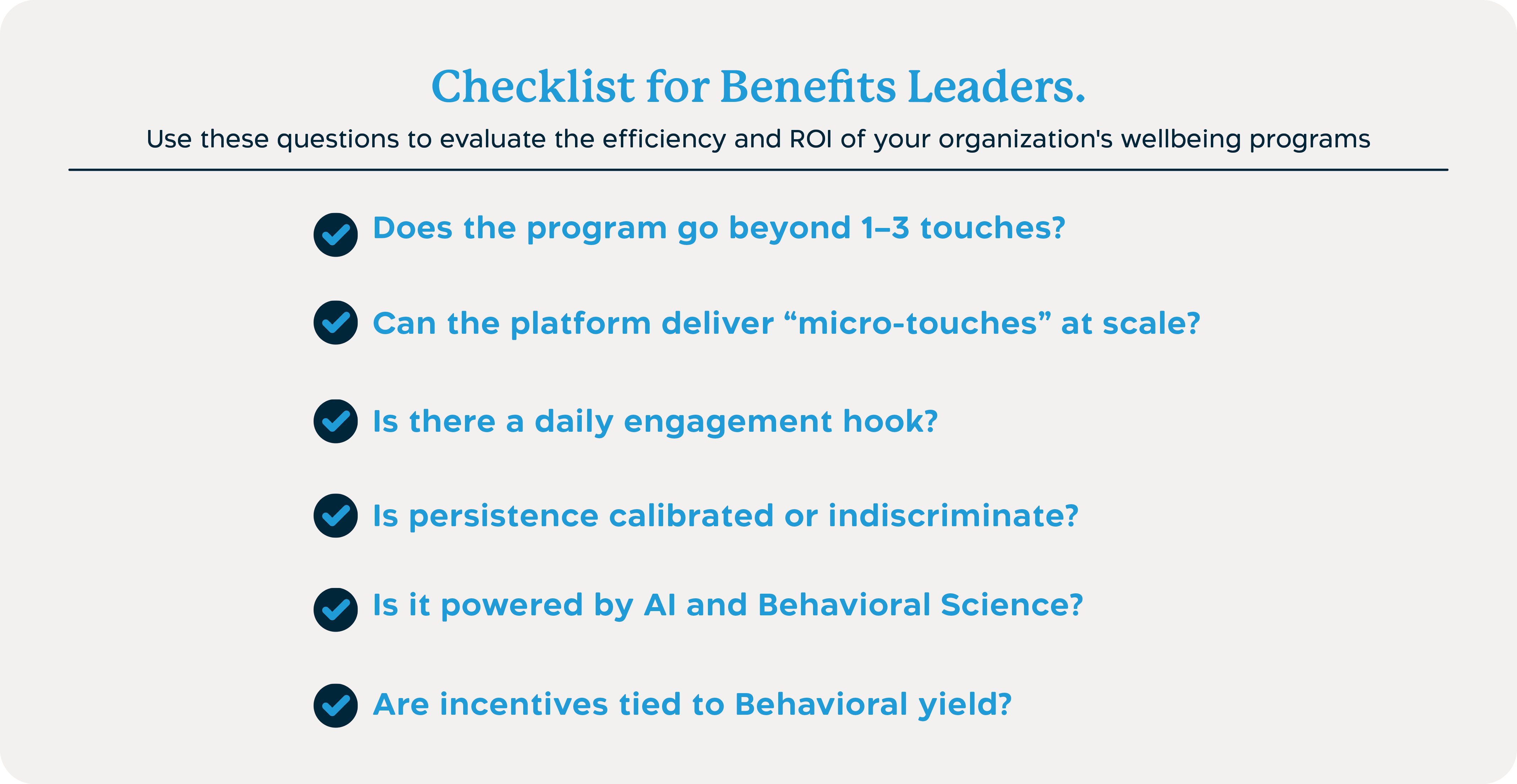
For HR and benefits leaders, this reframes the decision entirely: You’re not choosing another well being program. You’re choosing a cost-management engine powered by behavioral precision and AI-driven persistence. The road to reduced cost runs through improved employee adherence to proven health actions, and persistence sized to fit each individual is the best way to get there.